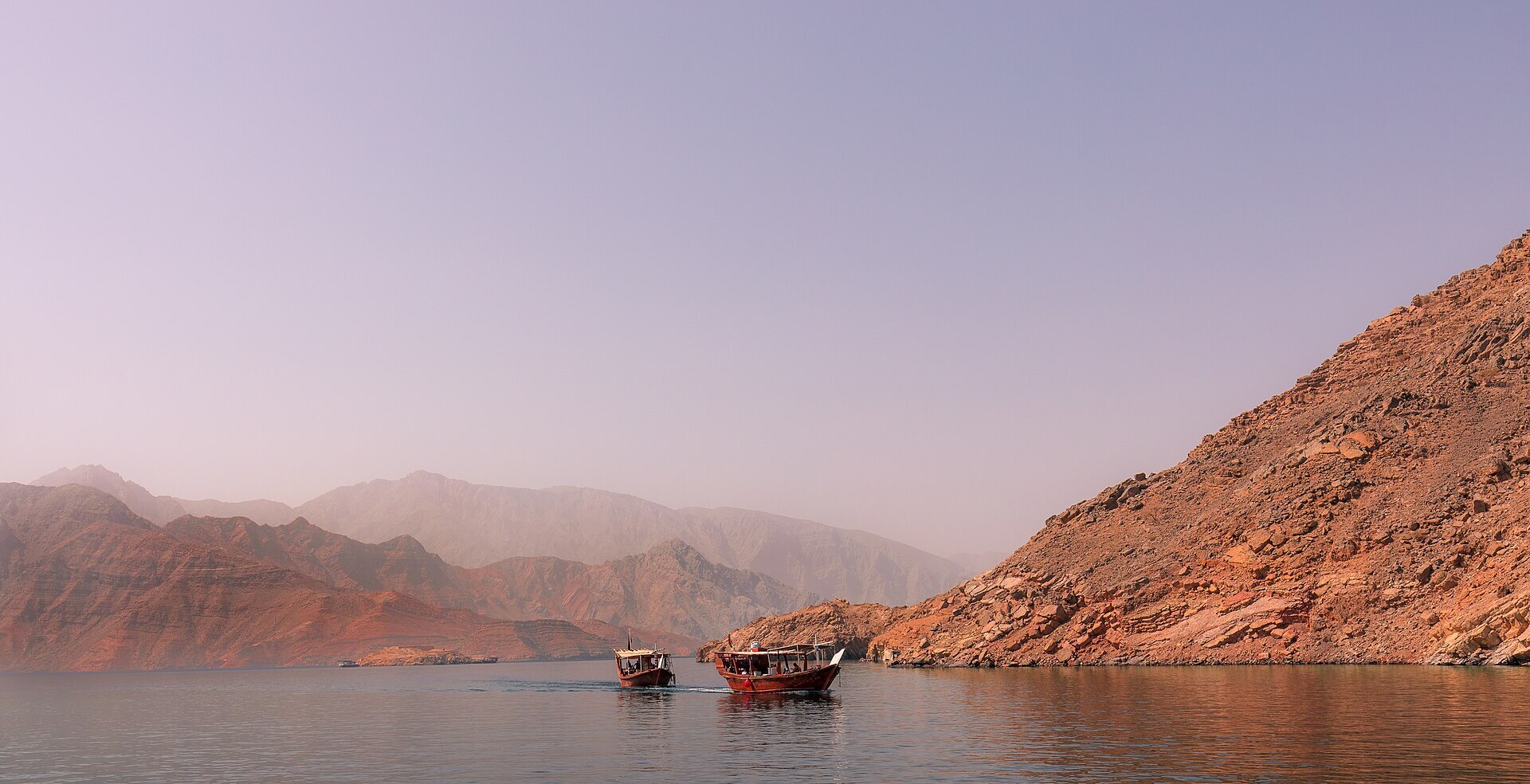
Telegraph Island is a small, bare outcrop sitting in the middle of Khor ash Sham, the longest and most visited of Musandam's fjords. From the water it looks unremarkable: a low hump of rock with the stumps of a few stone walls, no shade, no beach worth the name. Its fame rests entirely on what happened there in the 1860s, when it briefly became one of the most isolated postings in the British Empire. The ruins are modest, but the story explains why every dhow itinerary in Khor ash Sham still stops here, and why the phrase "going round the bend" is sometimes, a little too neatly, traced back to this stretch of water.
Why a telegraph station sat in a fjord
In the 1860s the British Empire was racing to link London and Bombay (now Mumbai) by electric telegraph, cutting communication times from weeks to hours. One route ran an undersea cable through the Persian Gulf, with relay stations needed at intervals to maintain the signal. The Royal Navy and the Telegraph Construction and Maintenance Company chose a small island inside Khor ash Sham, then part of the Musandam exclave under Omani and British-influenced administration, as a station site around 1864. The sheltered, deep-water khor offered calm anchorage for cable-laying ships and some protection from both weather and raiding parties, which mattered more than comfort for the men stationed there.
Life on the island: heat, isolation, and the "bend" story
Conditions were severe. Summer temperatures in Musandam regularly climb past 45°C, with the bare rock offering no natural shade and little breathing wind inside the fjord walls. Fresh water had to be shipped in. Contact with the outside world was limited to passing supply vessels, and the posting was considered one of the most punishing in the telegraph network, grouped mentally with other grim outstations of the era. The popular claim that the English phrase "going round the bend" originated here, from men driven to distraction by the heat and isolation, is a well-worn travel anecdote rather than a documented etymology; most dictionaries trace the phrase to unrelated 19th and 20th century English usage. It is worth repeating as local lore, not as settled fact.
What remains to see today
The telegraph line itself was short-lived: overland and alternative submarine routes elsewhere in the Gulf made this particular relay station redundant within a few years, and it was abandoned not long after. What survives on the ground is limited: low stone wall foundations, some flattened terracing, and scattered rubble, enough to outline where small buildings once stood but not enough to reconstruct a full plan without a guide pointing out the layout. There is no signage, no visitor center, and no fee to land, though most visitors see the island from the water rather than stepping ashore, since landing spots are narrow and currents around the rock can be brisk.
Bring your own shade and water: there is none on the island. Reef shoes help if you plan to snorkel the surrounding water, since the seabed near the rock is mixed coral and stone. Most dhow captains allow 20 to 40 minutes at anchor here, often combined with a snorkel stop just off the island.
Getting there: the standard dhow route
Telegraph Island sits roughly 45 minutes to just over an hour by traditional dhow from the main jetty in Khasab, depending on the boat's speed and whether the route includes other stops in Khor ash Sham first. Full-day dhow cruises from Khasab, typically running six to seven hours and priced from around 10 to 20 OMR per person in a shared group booking, almost always include Telegraph Island as a fixed waypoint alongside a lunch stop and a chance of dolphin sightings on the open water approach. Private dhow charters cost considerably more but allow more time anchored near the island and flexible snorkeling. Dolphins are common but never guaranteed on any given run; treat a sighting as a bonus, not a promise.
Best season and timing
October to April is the practical window for a comfortable cruise: daytime temperatures sit in the mid-20s to low 30s Celsius, and the water is calm enough for most boats to run full schedules. Midsummer trips (June to August) still operate, usually departing earlier in the day to avoid peak heat, but the exposed rock of Telegraph Island becomes genuinely uncomfortable to stand on by late morning. Friday departures from Khasab tend to be busier with domestic visitors; a weekday morning slot, when available, usually means a quieter anchorage at the island itself.
A short, specific piece of empire
Telegraph Island never functioned for long and never carried the volume of traffic its planners hoped for, but it captures something true about Musandam's position: a narrow, defensible strip of coast that outside powers have repeatedly found useful for watching the strait, relaying signals, or simply anchoring out of the wind. The stones that remain are unglamorous, and that is rather the point. Nobody built anything grand here; they built just enough to survive a posting, then left.